- Why Performance Testing Is Still an Afterthought in Most DevOps Pipelines (And Why That’s Expensive)
- Diagnosing and Eliminating Pipeline Bottlenecks: A Practical Framework
- Embedding Performance Tests Directly into Your CI/CD Pipeline: Stage by Stage
- Automation Best Practices: Building Performance Test Scripts That Don’t Become a Maintenance Nightmare
- Choosing and Integrating the Right Performance Testing Tool for Your DevOps Stack
- References
Why Performance Testing Is Still an Afterthought in Most DevOps Pipelines (And Why That’s Expensive)
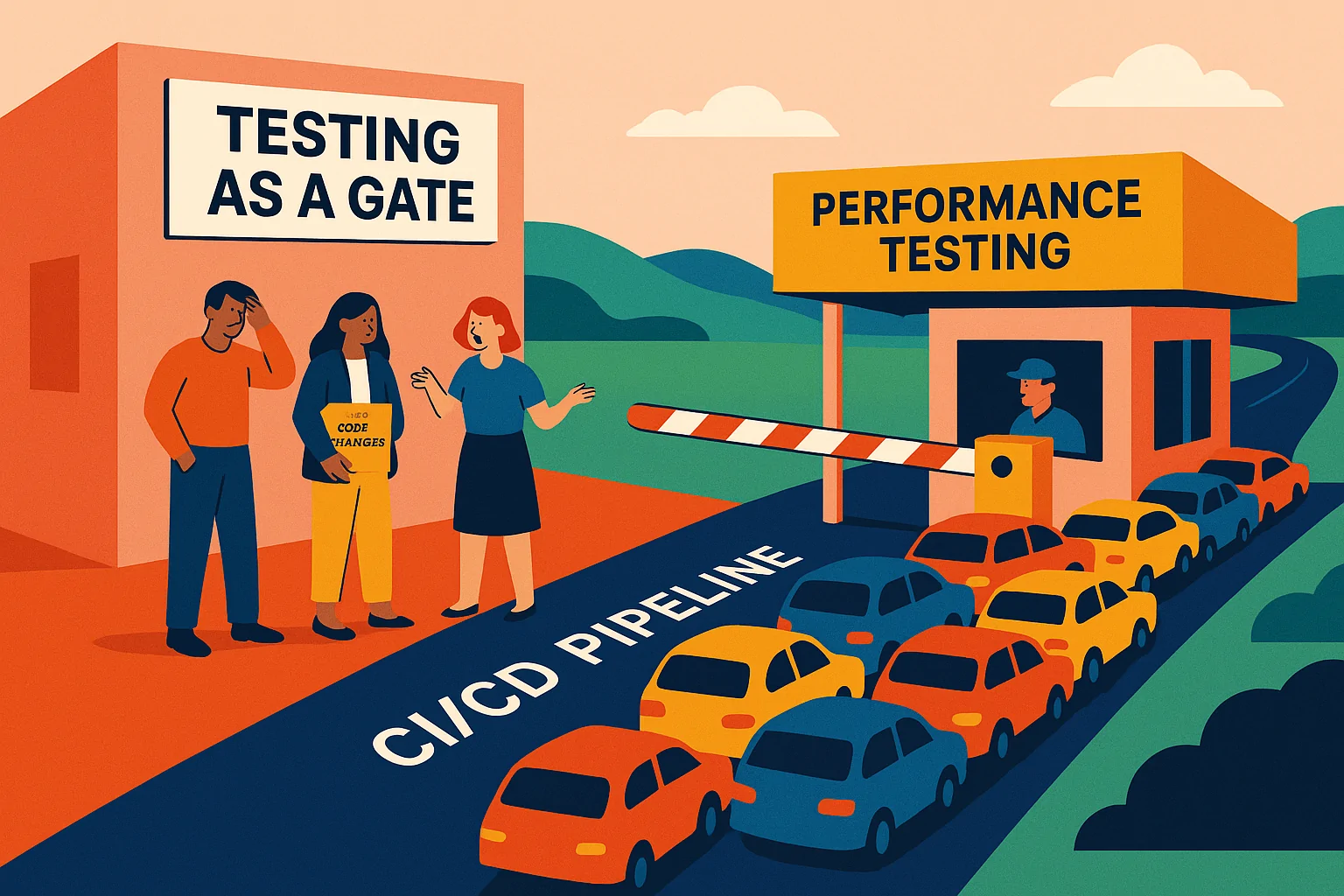
The ‘Testing as a Gate’ Mindset and Where It Breaks Down
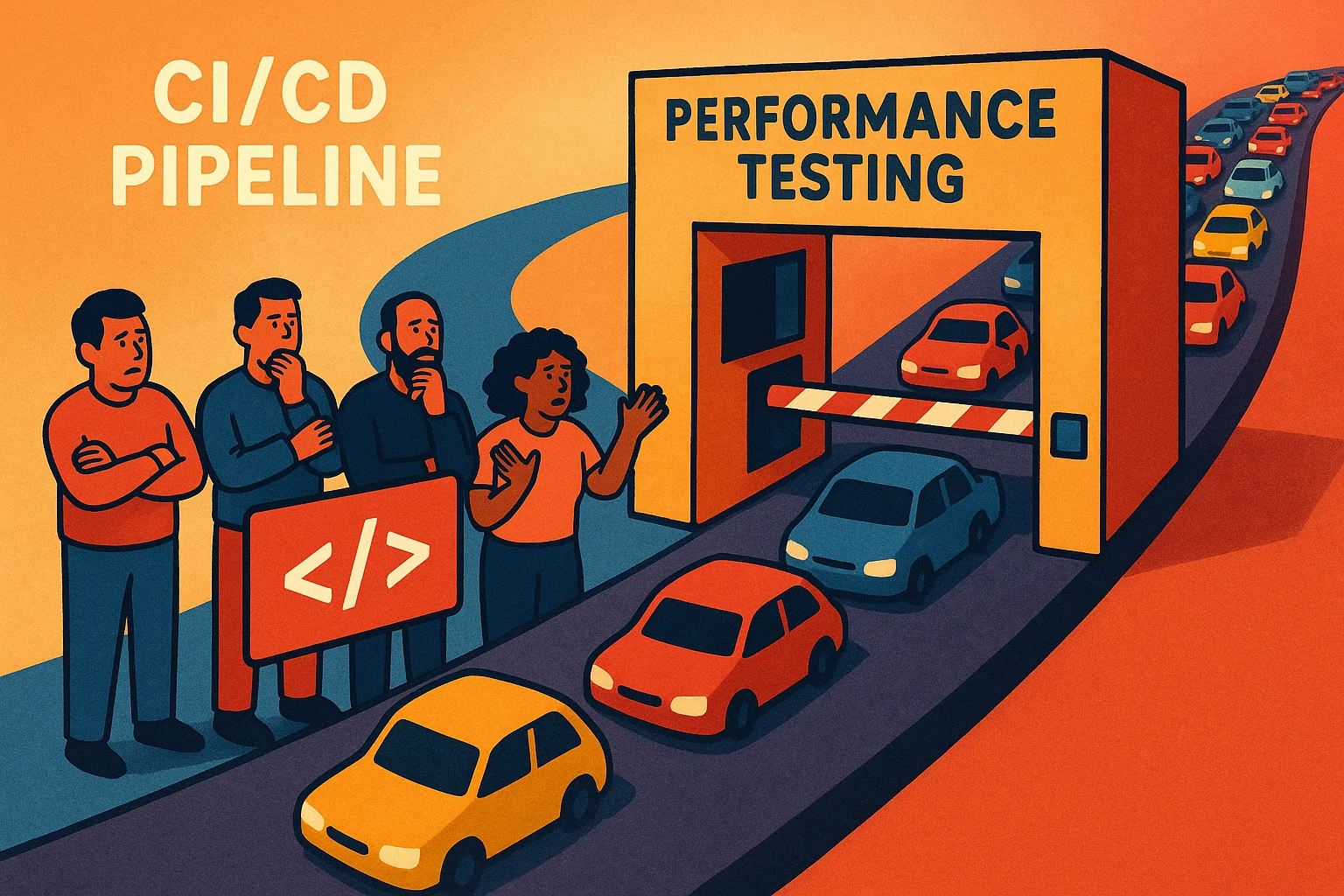
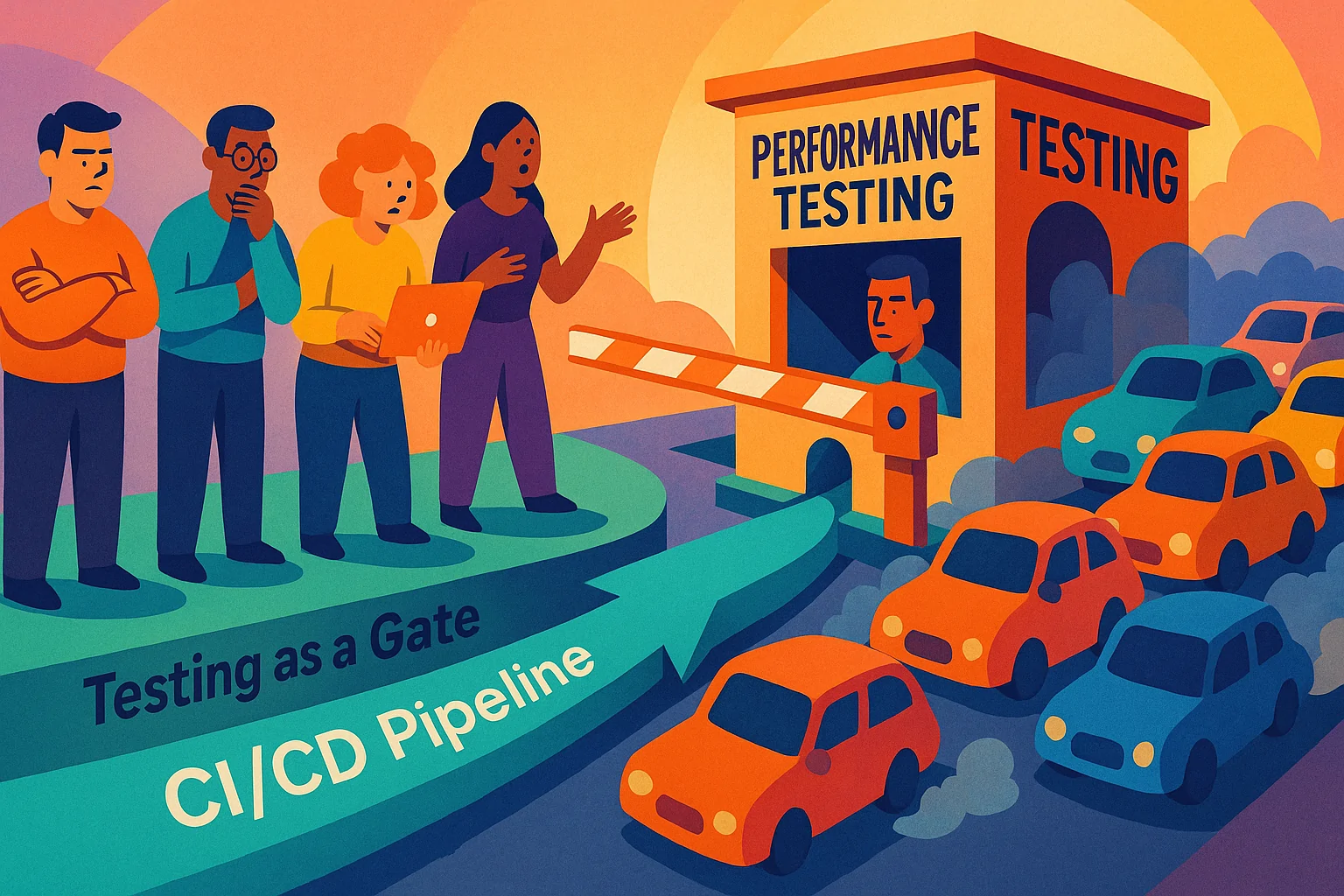
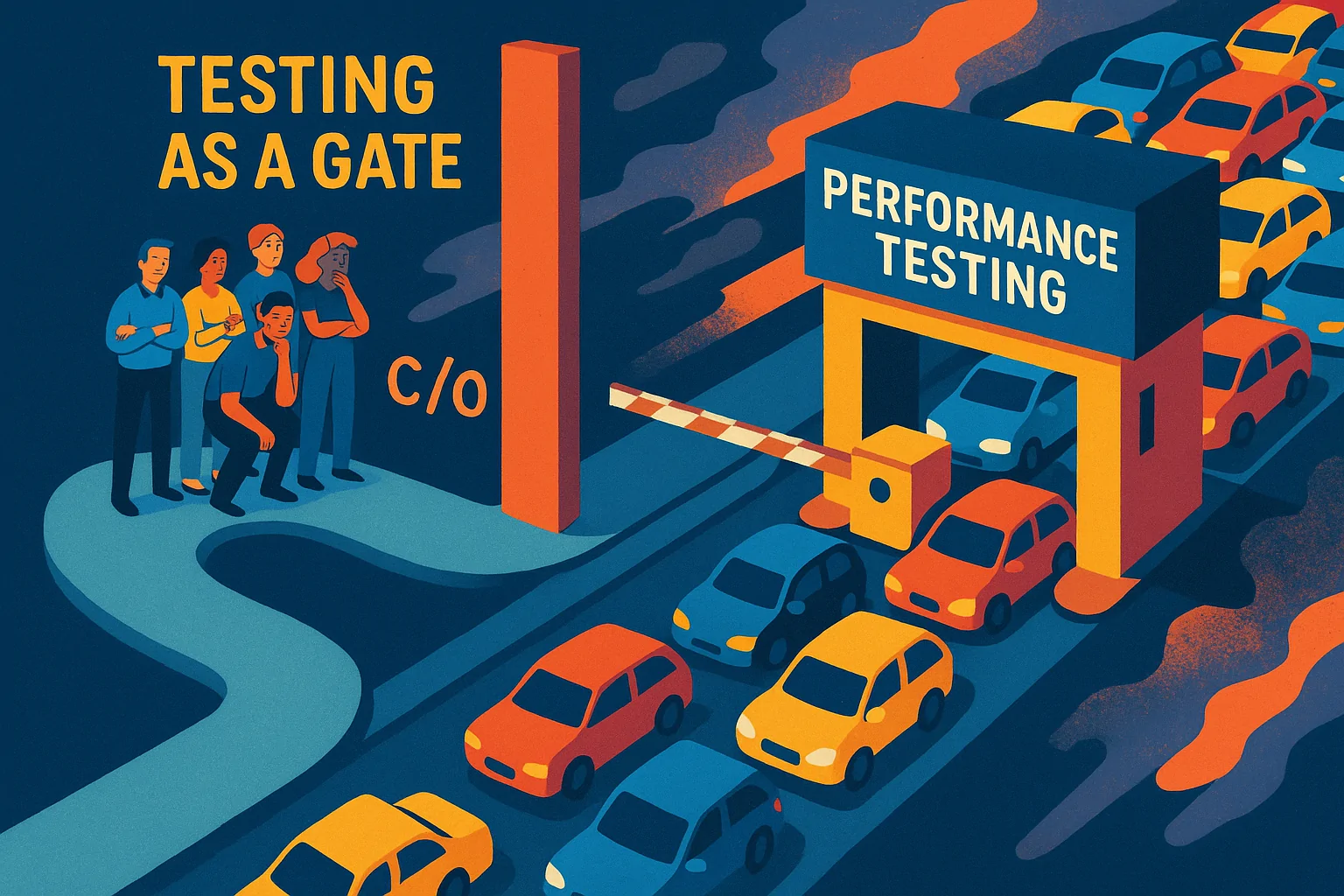
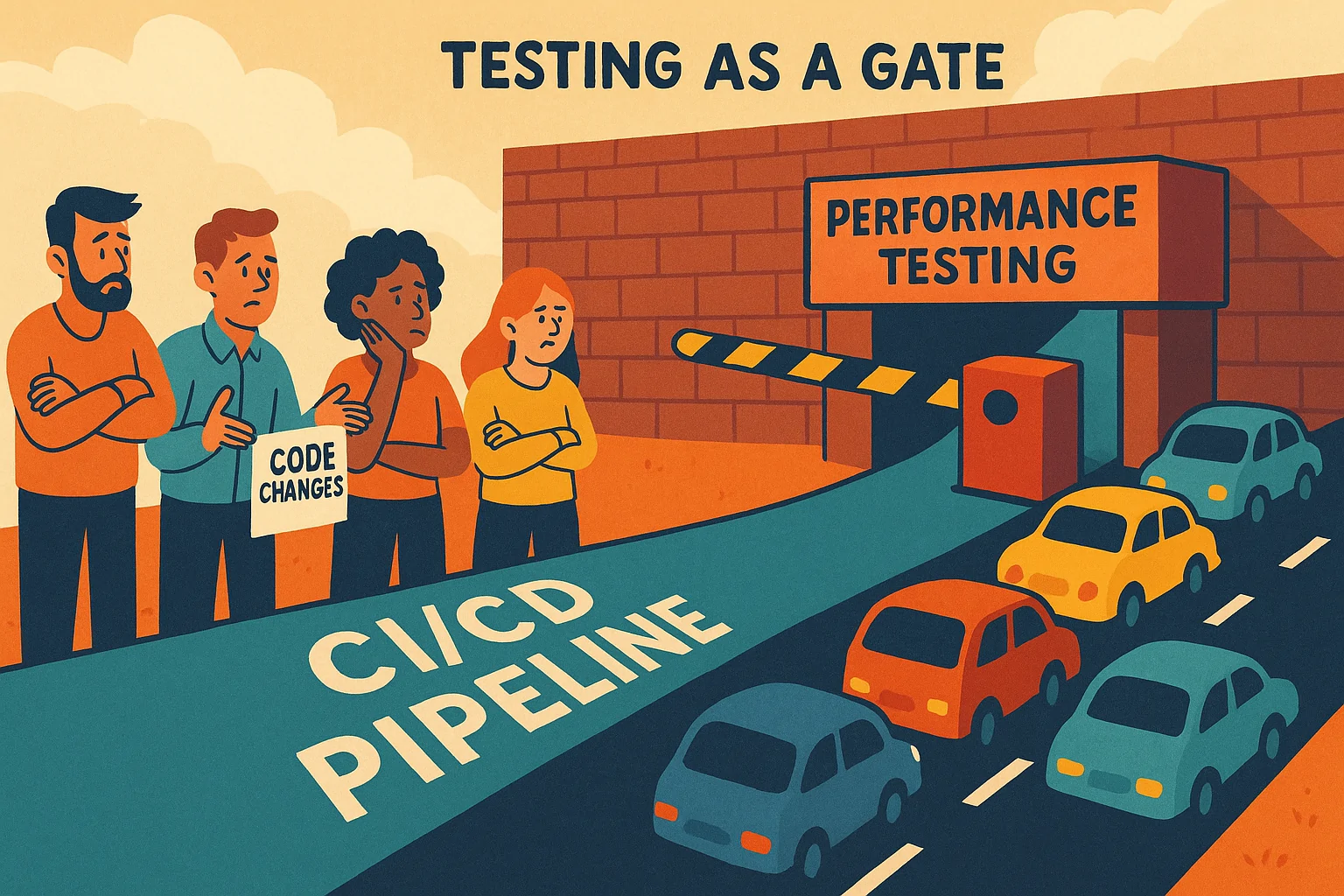
The traditional model treats performance testing as a discrete phase — a tollbooth before production. In organizations shipping quarterly, that model was tolerable. In CI/CD environments pushing multiple deploys per day, it becomes a release-blocking chokepoint that paradoxically makes production less reliable.
Here’s the failure mode: when performance testing only happens at staging, regressions accumulate silently across sprints. A p99 that started at 80ms in January drifts to 180ms by March, then spikes to 400ms after a seemingly innocent ORM change in April — but nobody notices until the staging load test finally runs and fails, blocking a release that contains 47 other commits. Discover how to effectively assess and alleviate these performance bottlenecks in the detailed guide on test and identify bottlenecks in performance testing.
As Alex Perry and Max Luebbe write in Google’s Site Reliability Engineering Book: “a 10 ms response time might turn into 50 ms, and then into 100 ms… A performance test ensures that over time, a system doesn’t degrade or become too expensive” [3]. This silent degradation pattern is the direct consequence of the gate mindset.
DORA’s research directly contradicts the assumption that thorough testing requires slowing the pipeline. Their data shows that “speed and stability are not tradeoffs. In fact, we see that the metrics are correlated for most teams. Top performers do well across all five metrics, and low performers do poorly” [1]. Teams that deploy frequently and test continuously maintain lower change fail rates than teams that batch changes into infrequent, high-risk releases.
Martin Fowler reinforces this in his foundational guide to Continuous Integration: “the usual bottleneck is testing — particularly tests that involve external services such as a database” [4]. The gate model doesn’t just delay feedback — it makes testing itself the bottleneck it was meant to prevent.
What Continuous Performance Testing Actually Means in a Modern Pipeline
Continuous performance testing isn’t a tool configuration — it’s a practice architecture. The core principle: different pipeline stages require different test depths, and no single test tier replaces the others. To truly understand its meaning and application, refer to insights on integrating performance testing in CI/CD pipelines.
A practical two-tier model looks like this:
- Commit-stage smoke test (every PR merge): 10-20 virtual users, 2-3 minutes, critical-path endpoints only. Pass criteria: p95 < 200ms, error rate < 0.5%. Execution budget: under 5 minutes total.
- Release-stage load validation (release branch): 200+ virtual users, sustained for 30 minutes at 2x expected peak load. Pass criteria: p99 < 500ms, error rate < 0.1%, throughput ≥ baseline ±5%.
The SRE rationale for this approach is concrete. Perry and Luebbe describe the zero-MTTR principle: “It’s possible for a testing system to identify a bug with zero MTTR… Such a test enables the push to be blocked so the bug never reaches production” [3]. A commit-stage performance gate is the closest achievable approximation of zero-MTTR for performance regressions — the regression never ships, so there’s nothing to recover from.
This tiered model follows Martin Fowler’s deployment pipeline architecture — a fast commit build followed by progressively deeper secondary stages [4] — adapted specifically for performance validation. The rest of this guide walks through each stage in detail, along with the bottleneck elimination, automation, and tooling strategies that make it work at enterprise scale.
Diagnosing and Eliminating Pipeline Bottlenecks: A Practical Framework
Before prescribing solutions, you need the diagnostic instruments to characterize your specific bottleneck. DORA’s guidance is direct: “Have the whole team commit to making an improvement in the most significant constraint or bottleneck. Turn that commitment into a plan, which may include some more specific measures that can serve as leading indicators for the software delivery metrics” [1].
Infrastructure-Level Bottlenecks: Resource Contention, Scalability Ceilings, and Environment Parity
Three infrastructure-layer issues account for the majority of unreliable performance test results:
Resource contention. When the load generator runs on the same CI agent as the application under test, both compete for CPU and memory. If your load generator host exceeds 70% CPU utilization during test execution, thread scheduling latency inflates measured response times by 15-40%, producing false regressions that erode trust in the pipeline. Solution: dedicate load generation infrastructure, either on isolated hosts or cloud-based generators that scale independently.
Scalability ceilings. A single on-premises load generator might cap out at 500-1,000 virtual users — far below the concurrency needed to validate a microservices application serving 50,000+ concurrent sessions. Teams hit this wall and either skip the test or run it at unrealistic volumes. The solution is a load generation platform that scales horizontally across cloud instances while maintaining a single control plane — a hybrid cloud/on-premises capability that WebLOAD supports natively. Discover more about how to load test concurrent users.
Environment parity gaps. Staging environments that use smaller database instances, fewer application replicas, or synthetic network conditions produce test results that don’t predict production behavior. A test that passes against a 2-node staging cluster tells you nothing about behavior on a 12-node production deployment behind a CDN. The NIST Special Publication on DevOps Pipeline Implementation reinforces that infrastructure consistency is a prerequisite for reliable automated validation in enterprise microservices architectures.
Process-Level Bottlenecks: Toolchain Gaps, Manual Handoffs, and Integration Friction
Infrastructure is only half the bottleneck picture. Process-level friction is often harder to spot: explore this in detail through valuable insights on performance testing practices.
Run this integration audit against your current performance testing workflow:
- Can your performance test tool trigger automatically from a pipeline webhook or event — without someone clicking “Run” in a separate UI?
- Do pass/fail results surface as a native pipeline status check that blocks the merge if thresholds are breached?
- Are test results stored alongside build artifacts, or do engineers need to log into a separate dashboard to find them?
- Can threshold definitions be version-controlled in the same repository as the application code?
If any answer is “no,” you have a process bottleneck that will cause performance testing to be skipped under deadline pressure. As Fowler notes, “Every minute chiseled off the build time is a minute saved for each developer every time they commit” [4]. The same calculus applies to performance test friction — every manual handoff is a point where the test gets skipped.
Building Your Bottleneck Resolution Backlog: Prioritization and Measurement
Not all bottlenecks deserve equal urgency. Use DORA’s five-metrics framework as the scoring lens:
| Bottleneck | DORA Metric Impact | Implementation Effort | Priority |
|---|---|---|---|
| Load generator co-located with app (false regressions) | Change fail rate ↑, deployment frequency ↓ | Medium (infra provisioning) | High |
| Manual test triggering | Change lead time ↑, deployment frequency ↓ | Low (webhook config) | Critical |
| No baseline comparison | Change fail rate ↑ (regressions missed) | Medium (tooling + storage) | High |
| Staging/prod parity gap | Failed deployment recovery time ↑ | High (infra redesign) | Medium |
Track a leading indicator weekly: average performance test execution time per pipeline run. Target under 5 minutes for commit-stage smoke tests, under 25 minutes for staging-stage load tests. When that number trends down without sacrificing test coverage, you’re resolving bottlenecks — not just rearranging them.
Research indicates Agile-aligned sprint-based improvement cycles improve team productivity by approximately 25% [5], which makes quarterly bottleneck resolution sprints a high-ROI investment.
Embedding Performance Tests Directly into Your CI/CD Pipeline: Stage by Stage
This section translates the tiered testing model into concrete pipeline configurations, following Martin Fowler’s deployment pipeline architecture and the Google SRE zero-MTTR principle [3]. Further insights can be found in the advanced guide to API performance testing.
Stage 1 — Commit and PR Gates: Lightweight Performance Smoke Tests
Covers the fastest, most developer-friendly tier of continuous performance testing: lightweight smoke tests triggered on every commit or PR that validate core API response times and error rates under minimal load. Explains what to test at this stage (critical path endpoints only), what to skip (full load simulation), and how to keep execution under 5 minutes to avoid blocking developer velocity.
Stage 2 — Integration and Staging Gates: Load and Scalability Validation
Describes the middle tier: more comprehensive load tests triggered on merges to integration or staging branches. Covers load model design (concurrent user ramp-up, think time, realistic request distribution), scalability tests, and how to compare results against a historical baseline to detect regression trends rather than just absolute threshold breaches.
Stage 3 — Release and Pre-Production Gates: Stress, Soak, and Spike Testing
Covers the most comprehensive tier: release-candidate validation through stress tests (finding the breaking point), soak tests (detecting memory leaks and degradation over sustained load), and spike tests (validating behavior under sudden traffic surges). Explains how to configure these as automated pipeline gates on release branches without requiring manual QA scheduling.
Automation Best Practices: Building Performance Test Scripts That Don’t Become a Maintenance Nightmare
Directly confronts the most frequently cited reason performance test automation stalls: brittle, expensive-to-maintain scripts that erode confidence in results and make it hard to justify ongoing investment. This section provides a practical architecture guide for building modular, reusable, maintainable performance test scripts — and introduces AI-assisted workflows as a production-ready capability that can dramatically reduce the maintenance overhead. The tone shifts here to be a bit more hands-on and concrete, with code-level thinking even if not full snippets.
Research indicates Agile-aligned sprint-based improvement cycles improve team productivity by approximately 25% [5], which makes quarterly bottleneck resolution sprints a high-ROI investment.
Architecting Modular, Reusable Performance Test Scripts
Explains the three-layer modular architecture pattern for performance test scripts: a data layer (parameterized inputs, user credentials, transaction data), a scenario layer (reusable user journey building blocks), and an assertion layer (centralized threshold definitions that can be updated without touching scenario logic). Shows how this architecture reduces the blast radius of application changes on test maintenance.
AI-Assisted Script Generation and Maintenance: What’s Real Today
Provides a clear-eyed, non-hyperbolic overview of what AI-assisted performance testing workflows actually deliver today — covering script generation from recorded traffic, intelligent correlation handling, anomaly detection during test runs, and self-healing assertions that adapt to minor UI or API changes. Explicitly distinguishes between production-ready capabilities and roadmap features, setting accurate expectations.
Managing Test Data, Documentation, and the Ongoing Maintenance Cadence
Covers the often-neglected operational practices that determine whether a performance test automation investment compounds over time or decays: test data management strategies (synthetic data generation, production data masking), documentation standards that make scripts readable by the whole team, and a quarterly maintenance cadence that keeps scripts aligned with application evolution.
Research indicates Agile-aligned sprint-based improvement cycles improve team productivity by approximately 25% [5], which makes quarterly bottleneck resolution sprints a high-ROI investment.
Choosing and Integrating the Right Performance Testing Tool for Your DevOps Stack
Provides the structured tool evaluation and integration methodology that none of the competing articles offer. Instead of listing tool names, this section gives engineering teams a decision framework — a set of evaluation criteria they can apply to any performance testing solution — and then demonstrates how to apply that framework with WebLOAD by RadView as a reference example. Addresses the cloud vs. on-premises deployment decision, protocol and application coverage breadth, scalability ceiling, CI/CD integration depth, and enterprise support requirements.
References
- DORA. (N.D.). DORA’s Software Delivery Performance Metrics. Retrieved from https://dora.dev/guides/dora-metrics-four-keys/
- Fowler, M. (2024). Continuous Integration. Martin Fowler. Retrieved from https://martinfowler.com/articles/continuousIntegration.html
- Bates, D. (Ed.). (2017). Testing for Reliability: A Google SRE Book. O’Reilly Media. Retrieved from https://sre.google/sre-book/testing-reliability/