A one-second delay in page load speed cost Amazon an estimated $1.6 billion in annual revenue. Mozilla discovered that shaving 2.2 seconds off a single download page generated 10 million additional Firefox downloads in one year. These aren’t hypotheticals, they’re peer-reviewed production measurements from organizations running performance infrastructure at global scale.
Yet most engineering teams still rely on testing approaches that would have been state-of-the-art in 2012: hand-maintained scripts, static threshold alerts, and load tests that only run, if they run at all, days before a release. Researchers from IBM Cloud and Toronto Metropolitan University put it bluntly in their 2025 ICSE-SEIP paper: “Traditional static or threshold-based methods fall short in addressing the complexity and scale of these systems.” Their study covered a microservices platform spanning seven data centers, 39,365 time-series rows, and 117,448 telemetry columns, a dimensionality that no human operator, and no static rule engine, can meaningfully monitor.
This guide is built for performance engineers, QA leads, SREs, and DevOps managers who are done with reactive firefighting. You won’t find a tool roundup or a glossary of terms you already know. Instead, you’ll get a practitioner’s framework for using AI to predict failures before production sees them, pinpoint bottlenecks in real time, and embed continuous performance testing into CI/CD without slowing down releases. Here’s the ground we’ll cover: why traditional testing is structurally failing, how AI mechanisms actually work under load, how to simulate real-world traffic that reflects production behavior, how to integrate AI load testing into your pipeline, and the questions you should be asking before choosing a platform.
- Why Traditional Load and Stress Testing Is Failing Modern Engineering Teams
- How AI Actually Works in Load and Stress Testing: The Core Mechanisms Explained
- Real-World Usage Simulation: Building Load Scenarios That Actually Reflect Production
- Integrating AI Load Testing into CI/CD: A Step-by-Step Framework for DevOps Teams
- Frequently Asked Questions
- Conclusion
- References and Authoritative Sources
Why Traditional Load and Stress Testing Is Failing Modern Engineering Teams
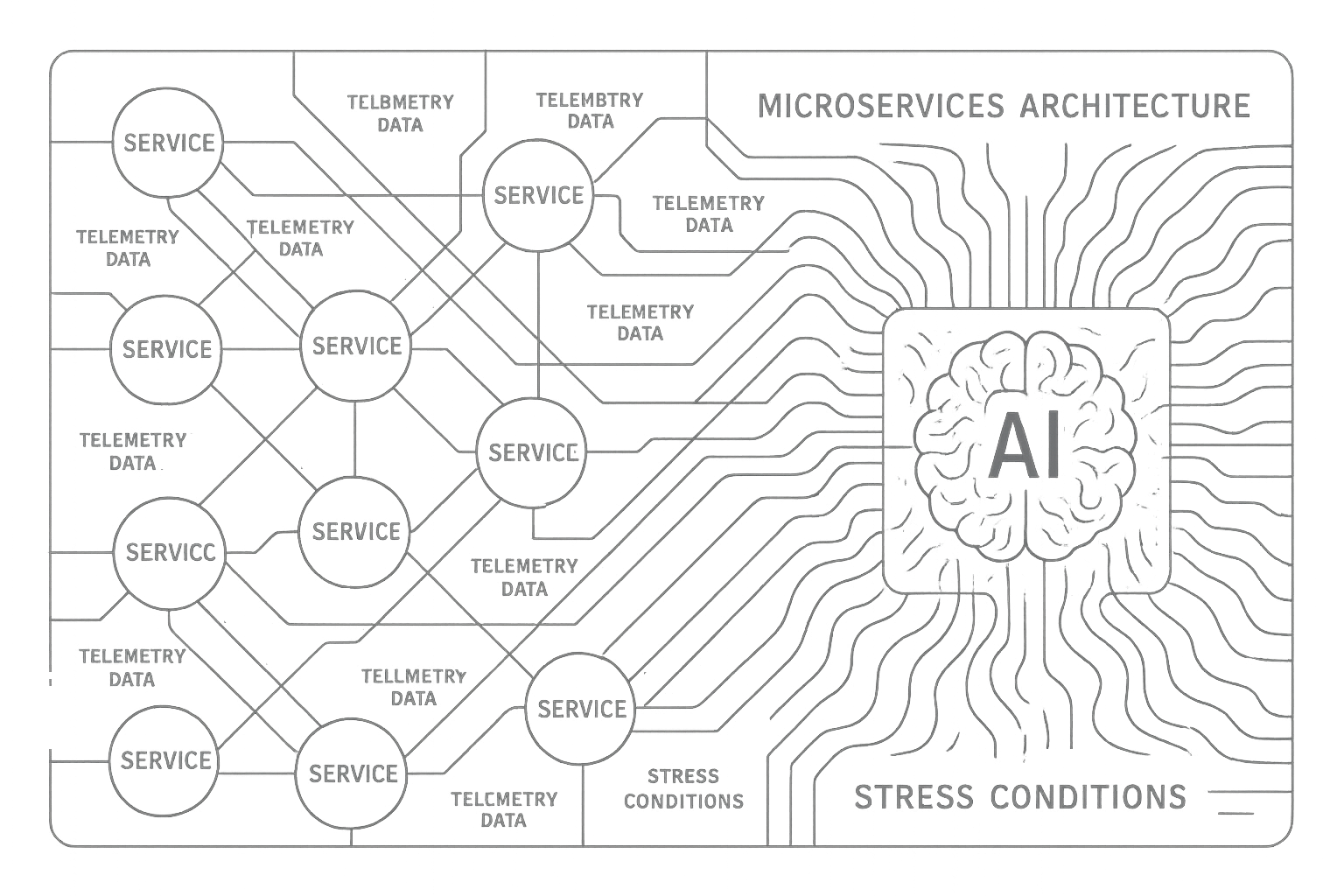
The problem isn’t that teams don’t care about performance testing. The problem is that the dominant testing paradigm, manually scripted scenarios evaluated against static thresholds, was designed for monolithic applications deployed on predictable infrastructure. It cannot keep pace with microservices architectures, ephemeral containers, and weekly (or daily) release cycles. The result is a widening gap between what testing catches and what production exposes.
The Script-Heavy Testing Trap: Why Manual Test Maintenance Breaks Down at Scale
Consider what happens when a team migrates a single monolith endpoint to a new microservice behind an API gateway. Every existing load test script that targeted the old endpoint path now returns 404s or redirects, silently invalidating coverage without triggering any failure in the test itself. Multiply that by 50 endpoints across three sprints, and you have a test suite that reports green while covering almost nothing.
IBM’s production telemetry study illustrates the scale problem: their Cloud Console system generated 117,448 distinct telemetry columns across seven data centers. No team can realistically write and maintain manual threshold rules for that dimensionality. The scripts become a liability faster than they provide value. QA leads report that existing approaches are “too slow, too script-heavy, or too disconnected from actual user behavior” to catch what matters. For a deeper look at the organizational cost of disconnected performance practices, SEI Carnegie Mellon: Performance Engineering in DevOps provides an excellent research foundation.
The Detection Gap: How Threshold-Based Monitoring Misses What Matters Most
A static alert rule, “fire if p99 latency exceeds 500ms”, can only detect a breach that has already occurred. It cannot detect a gradual degradation trajectory that will cross 500ms in 48 hours under current growth trends. Worse, static thresholds generate alert fatigue: in seasonal traffic patterns, a threshold calibrated for Tuesday morning traffic fires false positives every Friday afternoon, training engineers to ignore alerts entirely.
The IBM Cloud research team demonstrated the alternative: a GRU-based autoencoder trained on 4.5 months of production telemetry “identified the second anomaly early, demonstrating the model’s ability to proactively catch issues before they escalate.” The model learned the system’s normal behavioral patterns across 39,365 time-series rows and flagged deviations that a static threshold, unable to account for multivariate dependencies between CPU, memory, network I/O, and application latency, would have missed entirely. The growing body of research supporting this shift is well-documented in IEEE Transactions on Software Engineering: AI & Testing Research, and practitioners looking to understand which performance metrics matter most will find that multivariate correlation is central to effective anomaly detection.
The CI/CD Friction Problem: Why Performance Testing Gets Skipped in Fast Release Cycles
When a typical enterprise load test requires 4–8 hours of script preparation, 2–3 hours of execution, and another hour of manual result interpretation, it becomes the first thing cut under release pressure. Teams that deploy twice a week cannot afford a two-day performance testing cycle. The test becomes optional, and then it becomes nonexistent.
Mozilla’s engineering organization proved this cycle is breakable. Their Perfherder system processed 17,989 expert-validated performance alerts across 5,655 performance time series over 12 months, continuously, automatically, and integrated directly into their development workflow. That’s not a future aspiration; it’s operational reality at one of the world’s most trafficked software organizations. The SEI Carnegie Mellon: Performance Engineering in DevOps framework articulates why performance testing must be embedded in CI/CD rather than appended as a pre-release ceremony, and teams looking for practical implementation guidance can benefit from a detailed walkthrough on integrating performance testing in CI/CD pipelines.
How AI Actually Works in Load and Stress Testing: The Core Mechanisms Explained
“AI-powered testing” has become a marketing label applied to everything from regex-based log parsers to genuine neural network inference. This section strips away the ambiguity and explains the three specific mechanisms that distinguish real AI load testing from relabeled automation.
Anomaly Detection Under Load: How ML Models Spot What Human Eyes Miss
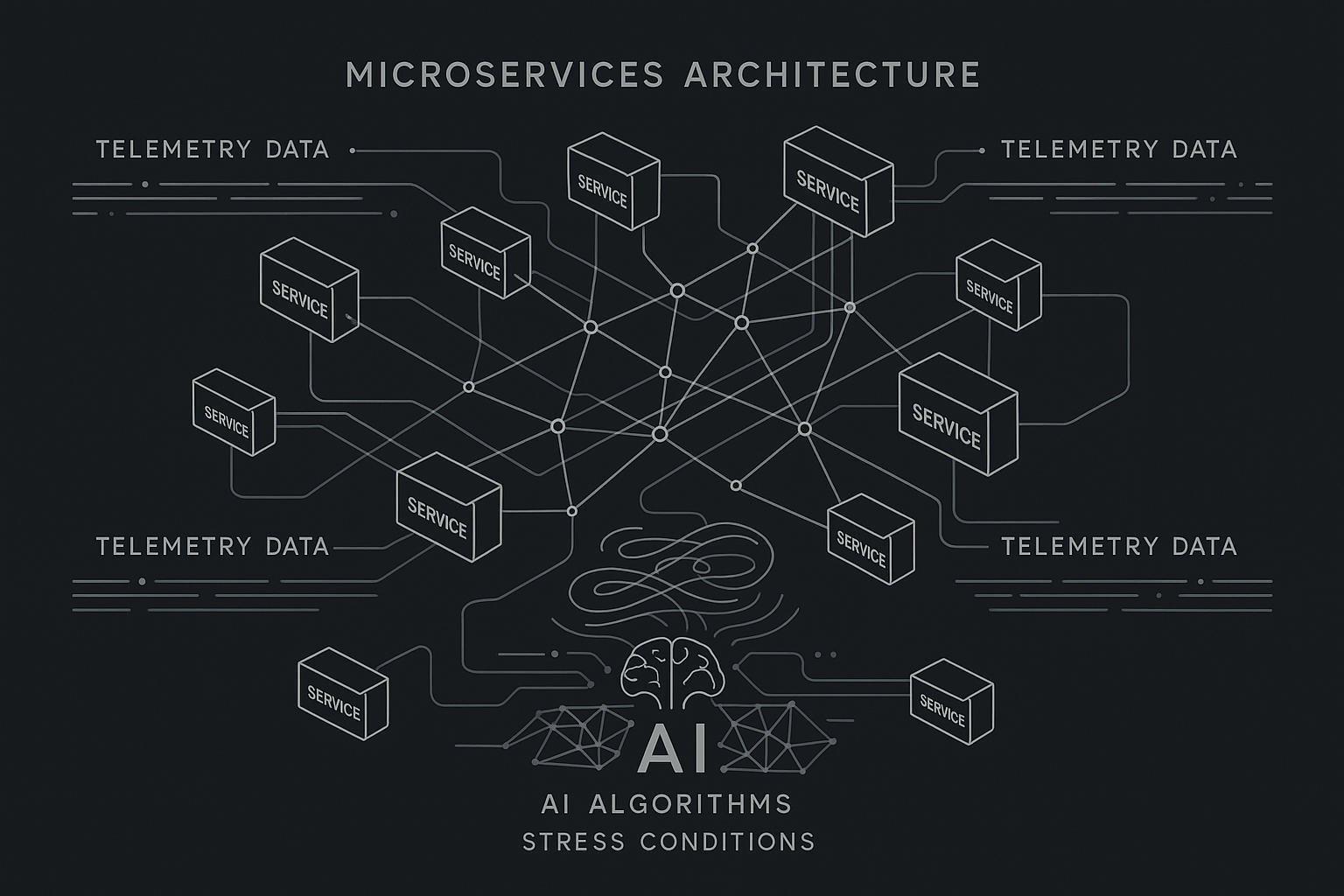
Time-series anomaly detection is the workhorse of AI load testing. The core idea: train an autoencoder (a neural network that learns to compress and reconstruct “normal” telemetry patterns) on historical performance data, then flag any test run where the reconstruction error exceeds a learned threshold. High reconstruction error means the system is behaving in a way the model has never seen, which, during a load test, is precisely what you want to know about.
The IBM Cloud team used a GRU (Gated Recurrent Unit) autoencoder, a recurrent neural network variant optimized for sequential data, trained on 4.5 months of production telemetry spanning 117,448 columns. Unlike a static p99 alert, the GRU model captures temporal dependencies: it understands that a gradual 12% increase in database connection wait time over 90 minutes, combined with a 3% rise in garbage collection pause frequency, constitutes a pre-failure pattern, even though neither metric individually crosses any threshold. Engineers still review and confirm flagged anomaly windows. This is augmentation, not full automation: the IBM researchers explicitly advocate human-in-the-loop refinement to reduce false positives and improve model precision over successive iterations.
Adaptive Scenario Generation: AI That Builds, and Rebuilds. Test Scripts Automatically
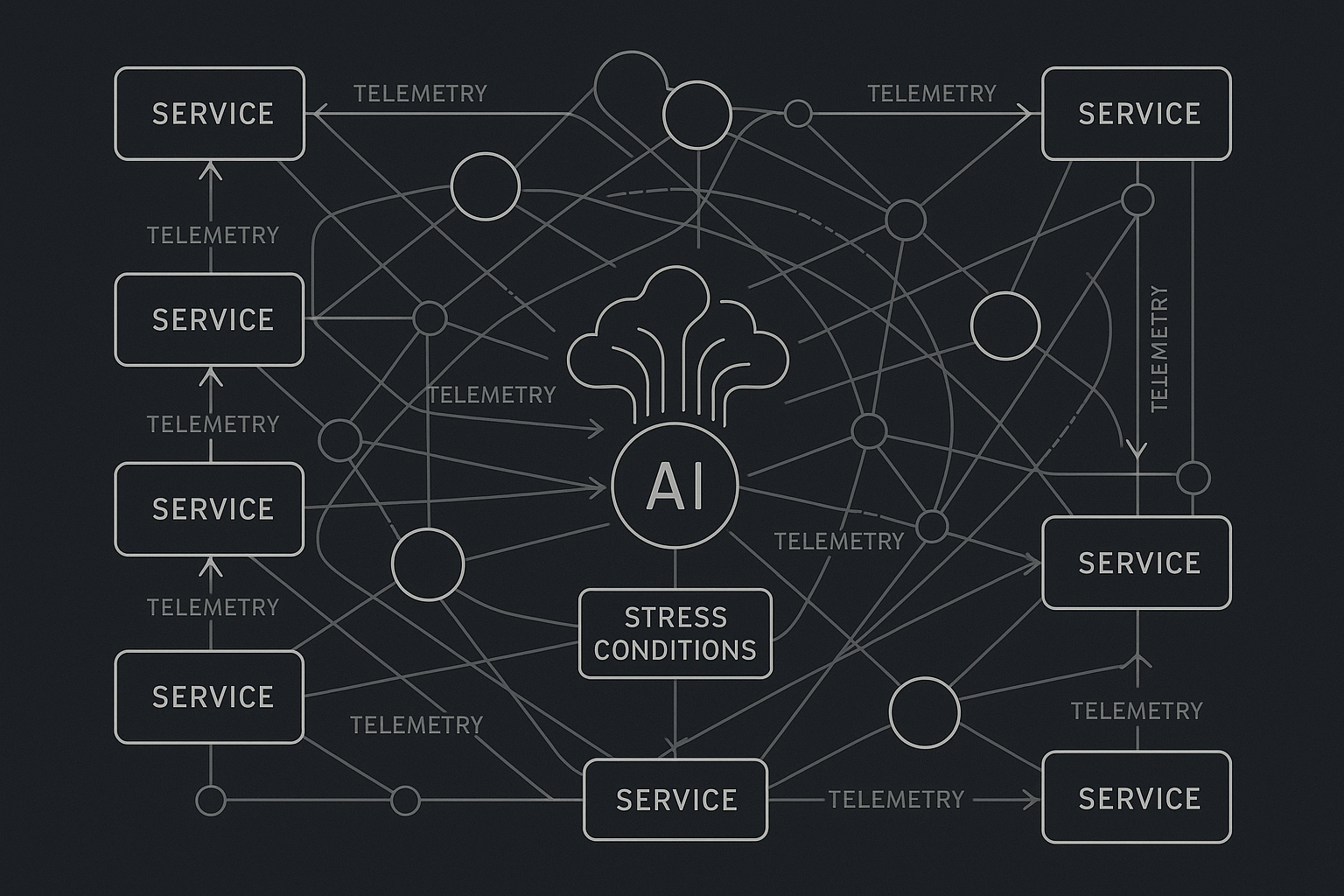
The second mechanism addresses the script maintenance problem directly. AI-powered platforms ingest production traffic logs. HTTP session recordings, API call sequences, user navigation paths, and auto-generate parameterized test scenarios that reflect actual user behavior distributions. When the application changes (a UI element selector is renamed, an API endpoint is versioned, a checkout flow adds a step), the platform detects the mismatch between recorded interactions and current application state and repairs the script without manual intervention.
This self-healing capability mirrors the Continuous Delivery for Machine Learning (CD4ML) framework defined by Thoughtworks’ Danilo Sato, Arif Wider, and Christoph Windheuser: “This is achieved either by collecting more real data or by adding a human in the loop to analyse the new data captured from production, and curate it to create new training datasets for new and improved models.” Applied to load testing, this means each production deployment generates data that improves the next test cycle’s scenario fidelity, a continuous learning loop, not a static script library. WebLOAD’s JavaScript-based scripting engine supports this adaptive approach, allowing teams to combine recorded sessions with programmatic parameterization to generate scenarios that evolve with the application.
Predictive Load Modeling: Forecasting Failure Before Production Ever Sees It
The third mechanism extends beyond detection into prediction. ML models trained on historical load test results and production telemetry can project capacity curves forward, answering “at what concurrency level will p99 latency exceed our SLA?” before you actually run a test at that concurrency.
For example, after three successive load test runs at 2,000, 5,000, and 7,000 concurrent users, a regression model can identify the degradation inflection point and predict: “p99 latency will exceed 500ms at approximately 8,500 concurrent users based on the observed exponential growth in database connection pool saturation.” Mozilla’s Perfherder system demonstrates the production-scale version of this approach, maintaining 5,655 active performance time series with automated alert triage, effectively performing continuous capacity monitoring against historical trends. The Thoughtworks CD4ML framework reinforces this with the concept of “threshold tests”, automated checks that verify system performance remains above minimum acceptable levels, triggering investigation when the trend line threatens to cross. For teams looking to understand how this predictive approach compares to conventional methods, a detailed comparison of AI vs traditional load testing provides practical context.
Real-World Usage Simulation: Building Load Scenarios That Actually Reflect Production
The most technically sophisticated AI anomaly detector is useless if the load test it’s monitoring doesn’t resemble production traffic. Most performance test failures in production aren’t caused by raw volume, they’re caused by specific behavioral combinations that the test never modeled. For authoritative grounding on reliability modeling within load scenarios, the IEEE Std 1633: Software Reliability Recommended Practice provides the standards-level framework.
Moving Beyond Uniform Load: Designing User Journey-Based Stress Tests
A “ramp to 10,000 virtual users and hold for 30 minutes” test tells you one thing: whether the system survives 10,000 identical requests. It tells you nothing about what happens when 60% of those users are browsing product catalogs (read-heavy, CDN-cached), 25% are adding items to cart (write-heavy, session-stateful), and 15% are completing checkout (transaction-heavy, payment-gateway-dependent, database-locking). The failure modes are completely different: the browse users saturate edge nodes, the cart users exhaust session store memory, and the checkout users trigger payment API timeouts under contention.
AI-powered platforms derive these user journey profiles automatically from production access logs, clustering observed behavior patterns into virtual user personas weighted by actual traffic distribution. RadView’s platform supports this through its JavaScript scripting engine, enabling teams to define distinct behavior-driven virtual user types and mix them in proportions matching real production ratios, including parameterized session tokens, unique credentials per virtual user, and dynamic form data generation. For a comprehensive methodology on building these scenarios, see this guide on creating realistic load testing scenarios.
Spike, Soak, and Surge: Matching Your Stress Test Type to Your Risk Profile
Not every test should be the same shape. The test type must match the failure mode you’re trying to surface:
- Spike: Sudden capacity overload, autoscaler lag. Recommended Pattern: Ramp from baseline to 5x load in 60 seconds, hold 5 min. Example Scenario: Black Friday flash sale hitting checkout API.
- Soak: Memory leaks, connection pool exhaustion, slow resource degradation. Recommended Pattern: Sustained 70–80% peak load for 4–12 hours. Example Scenario: SaaS platform during a normal business day.
- Surge: Maximum throughput ceiling, cascading failures. Recommended Pattern: Incremental ramp to system breaking point. Example Scenario: Capacity planning for a product launch.
Mozilla’s automated regression detection pipeline serves as a real-world soak-equivalent: by continuously monitoring 5,655 performance time series over 12 months, their system surfaces slow-burn degradations, a 2% weekly increase in median page load time, for instance, that a 30-minute spike test would never detect. For a deeper dive into each of these test types and when to apply them, see the guide on different types of performance testing explained.
How WebLOAD Simulates Real-World Traffic at Scale: A Practical Walkthrough
Setting up a realistic simulation in WebLOAD follows a concrete sequence of practitioner decisions. First, import captured HTTP session recordings from production or staging, these become the behavioral template. Next, parameterize the sessions: replace hardcoded session tokens with dynamic extraction functions so each virtual user authenticates independently, and substitute static form values with data-driven inputs from CSV feeds or database queries. Then configure load generator distribution. WebLOAD supports hybrid cloud and on-premises injection, so you can place generators in geographic regions matching your user base (e.g., 40% US-East, 30% EU-West, 30% APAC). Finally, define your virtual user mix: assign persona weights (browse, search, transact) that mirror production analytics ratios. This isn’t theoretical, organizations including CBC, FIU, and Georgia Tech have used this approach to validate production readiness under realistic conditions that open-source tools and SaaS-based platforms often struggle to replicate at the same protocol depth and hybrid deployment flexibility.
Integrating AI Load Testing into CI/CD: A Step-by-Step Framework for DevOps Teams
The Thoughtworks CD4ML framework defines the discipline: “a cross-functional team produces machine learning applications based on code, data, and models in small and safe increments that can be reproduced and reliably released at any time, in short adaptation cycles.” Apply that same principle to performance testing, and you get a continuously executing, continuously improving performance validation system, not a release-blocking ceremony.
Defining Your Performance Baseline and Regression Gates
Before any pipeline integration is meaningful, you need a stable baseline. Run your standard load scenario against a known-good build at least five times to establish statistical confidence intervals for your core metrics. Then configure regression gates with specific thresholds:
- p99 response time: Must remain below 300ms (or your application’s SLA target).
- Error rate: Must stay below 0.5% of total requests.
- Throughput degradation: Must not drop more than 10% versus the established baseline.
- Apdex score: Must remain above 0.85.
Mozilla’s performance sheriffing system maintains 5,655 active time series with automated alert triage, demonstrating that this level of baseline management is operationally sustainable at scale. The Thoughtworks CD4ML “threshold tests” concept applies directly: each gate is a model validation check that triggers investigation when the performance trend threatens to cross acceptable boundaries.
Pipeline Architecture: Where and When to Trigger AI-Powered Load Tests
Right-sizing test intensity to pipeline stage prevents performance testing from becoming a bottleneck:
- Pull Request: Smoke load test, 5 min. Scope: Critical API endpoints only, 10% peak load. Fail Criteria: p99 > 200ms OR error rate > 1%.
- Merge to Main: Scenario test, 15–20 min. Scope: Full user journey mix at 50% peak load. Fail Criteria: Any regression gate breach vs. baseline.
- Release Candidate: Full stress/soak, 1–4 hours. Scope: Production-equivalent load with spike injection. Fail Criteria: Any SLA violation or resource exhaustion.
WebLOAD supports API-driven test triggering and command-line execution, enabling teams to embed these graduated tests directly into Jenkins, GitLab CI, or GitHub Actions pipelines without manual intervention. The key architectural decision: run smoke tests on ephemeral infrastructure (spin up, test, tear down) to avoid environment contention, and reserve dedicated load generation infrastructure for release candidate tests where environmental consistency matters.
Closing the Feedback Loop: AI-Driven Result Triage and Continuous Improvement
The highest-leverage step in the entire process is what happens after the test completes. As Sato, Wider, and Windheuser write: “Closing this feedback loop is one of the main advantages of CD4ML, as it allows us to adapt our models based on learnings taken from real production data, creating a process of continuous improvement.” In practice, this means the testing platform’s AI correlation engine analyzes each run’s telemetry, identifies statistically significant deviations, and surfaces prioritized diagnostics. For example: after a release candidate stress test, WebLOAD’s intelligent correlation engine might flag that p99 latency spiked from 180ms to 620ms, correlated with a 340% surge in database connection pool wait time, occurring at exactly 6,200 concurrent users. That diagnostic, latency spike + root cause + concurrency threshold, is what the engineer needs to open a targeted Jira ticket, not a 200-page raw metrics dump. Teams looking to sharpen their bottleneck analysis workflow will find actionable techniques in this guide on how to test and identify bottlenecks in performance testing.
Over time, the IBM Cloud researchers found that human confirmation of AI-flagged anomalies creates a labeled dataset that improves model precision in subsequent runs. Each test cycle makes the next one smarter, fewer false positives, sharper anomaly boundaries, and increasingly accurate predictive models.
Frequently Asked Questions
Does AI load testing eliminate the need for manually designed test scenarios?
No, and any platform claiming otherwise is overpromising. AI excels at generating baseline scenarios from production traffic patterns, detecting anomalies humans would miss, and auto-repairing broken scripts. But edge-case scenarios (failover behavior, payment gateway timeouts, third-party API degradation) still require engineering judgment to design. The IBM ICSE-SEIP 2025 research explicitly recommends human-in-the-loop validation for AI-flagged results. Think of AI as handling the 80% of repetitive scenario maintenance so your team can focus on the 20% that requires domain expertise.
Is 100% load test coverage worth the investment?
Not always. Covering every endpoint at every concurrency level produces diminishing returns. A more effective strategy: identify your revenue-critical paths (checkout, authentication, search) and your highest-risk architectural boundaries (database connection pools, third-party API integrations, message queue consumers), then invest deeply in those. A focused test suite covering 30% of endpoints that represent 90% of business risk will catch more production incidents than a shallow suite covering every route.
How many load test runs do I need before my baseline is statistically reliable?
A minimum of five consecutive runs under identical conditions (same environment, same data, same load profile) is the practical floor. Calculate the coefficient of variation (standard deviation divided by mean) for each metric; if CV exceeds 10%, you have environmental instability that needs resolution before the baseline is trustworthy. Common culprits: shared staging environments with competing workloads, cold JVM or container start-up effects, and database cache warming differences between runs.
What’s the minimum infrastructure needed to start AI-powered load testing in CI/CD?
You don’t need a dedicated performance lab to begin. Start with a single load generator instance (cloud or on-prem) running smoke-level tests on pull requests. Graduate to multi-generator distributed tests as you mature. The key constraint isn’t hardware, it’s environmental consistency. An AI model trained on results from a shared staging environment with variable background load will learn noise, not signal. Dedicate at least one environment (even a small one) exclusively to performance testing.
How do I convince leadership to invest in AI load testing when manual testing “works”?
Frame it in incident cost. Calculate your organization’s average cost per production performance incident (engineering time × hourly rate × mean time to resolution, plus revenue impact during degradation). Then compare that to the cost of the performance regressions your current testing misses. The Mozilla data is compelling: a 2.2-second improvement on one page drove 10 million additional downloads. If your testing practice can’t quantify similar risk, it isn’t working, it’s just not failing visibly yet.
Conclusion
AI load testing isn’t a future-state aspiration, it’s an operational capability available today, backed by peer-reviewed research from IBM, Mozilla, and Thoughtworks, and already running in production at organizations processing billions of requests. The shift from reactive, script-heavy testing to predictive, AI-augmented performance engineering produces measurable outcomes: faster bottleneck identification, fewer production incidents, and defensible capacity planning grounded in statistical models rather than gut estimates.
The framework in this guide, establish baselines with specific regression gates, graduate test intensity across pipeline stages, close the feedback loop with AI-driven diagnostics, and simulate production-realistic traffic with behavior-driven scenarios, is immediately actionable. Start with smoke-level tests on your next pull request. Measure the delta. Iterate. Every test run makes the next one sharper.
*Performance benchmarks and test outcomes referenced in this article reflect specific configurations, infrastructure environments, and workload profiles. Results will vary based on your application architecture, infrastructure, and test design. This article is intended as practitioner guidance, not a guarantee of specific performance outcomes. WebLOAD examples reflect the platform’s capabilities as documented at time of publication; consult RadView’s official documentation for the most current feature set.*
References and Authoritative Sources
- Besbes, M.B., Costa, D.E., Mujahid, S., Mierzwinski, G., & Castelluccio, M. (2025). A Dataset of Performance Measurements and Alerts from Mozilla. ACM/SPEC International Conference on Performance Engineering (ICPE Companion 2025). Retrieved from https://arxiv.org/pdf/2503.16332
- Islam, M.S., Rakha, M.S., Pourmajidi, W., Sivaloganathan, J., Steinbacher, J., & Miranskyy, A. (2025). Anomaly Detection in Large-Scale Cloud Systems: An Industry Case and Dataset. IEEE/ACM 47th International Conference on Software Engineering: Software Engineering in Practice (ICSE-SEIP 2025). Retrieved from https://arxiv.org/pdf/2411.09047
- Sato, D., Wider, A., & Windheuser, C. (2019). Continuous Delivery for Machine Learning. MartinFowler.com (Thoughtworks). Retrieved from https://martinfowler.com/articles/cd4ml.html